
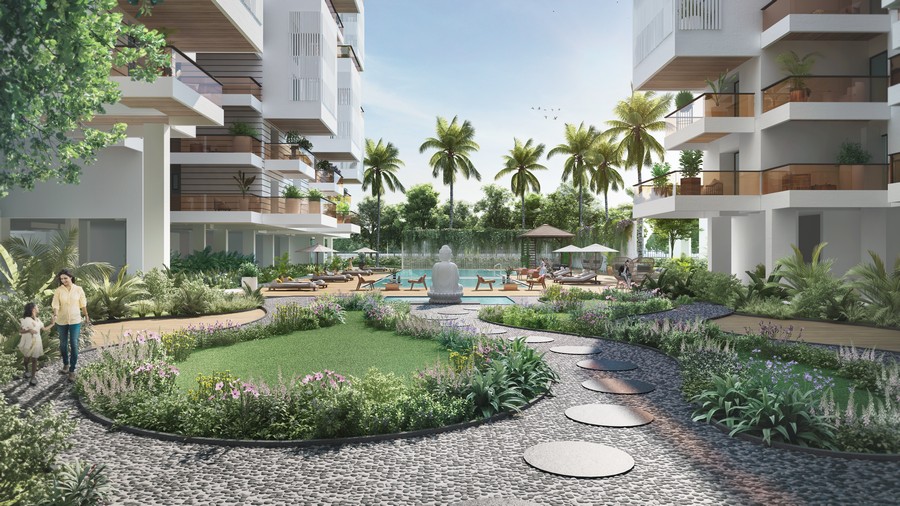
The luxury apartments complex that genuinely contributes to a healthier home is not the one with the best gym on the specification sheet. It is the one whose architectural decisions — orientation, window placement, building form, floor-to-ceiling heights — produce the natural light and ventilation quality that determines how the people living inside it feel every day. Natural light and ventilation are not supplementary features in residential design — they are the foundational ones. A well-lit, well-ventilated flat reduces reliance on artificial lighting and mechanical cooling, produces measurably better indoor air quality, and creates a living environment that supports the occupant’s circadian rhythm, mood, and respiratory health in ways that no amenity list replicates.
The connection between the design of a home and the health of the people who live in it has been well-established in environmental health research for decades. Inadequate natural light is associated with disrupted sleep cycles, reduced vitamin D synthesis, and mood disorders. Poor ventilation — particularly in the closed, air-conditioning-dependent homes that Guwahati’s climate can encourage — is associated with higher concentrations of indoor pollutants, increased respiratory irritation, and the mould and damp conditions that arise when condensation cannot escape through natural airflow.
For families evaluating a luxury apartments complex in Guwahati and wanting to understand which developments have designed for health through natural light and ventilation rather than having those qualities appear incidentally, this piece covers what to look for and why the difference matters more than the average specification comparison suggests.
What Natural Light in a Home Actually Does for the People Who Live There
Natural light in a residential flat is not simply illumination. It is the mechanism by which the body’s circadian rhythm is calibrated — the system that determines alertness during the day and sleep quality at night. A 3 BHK apartment whose principal rooms receive direct morning light on the east and north-east faces produces an occupant’s daily rhythm that is meaningfully different from one whose rooms face internally or towards the west, where the afternoon sun creates heat and glare rather than the gentle morning light the body uses to set its biological clock.
The new apartments in Guwahati’s premium market that have been designed with solar orientation in mind — where the developer has considered which rooms need morning light and which should be shielded from afternoon western sun — are building this health advantage into the flat’s DNA. A flat buy in Guwahati in a development where this thinking is evident delivers daily health benefits that no subsequent renovation can add.
Why Ventilation Design in a Luxury Apartments Complex Matters More Than Air Conditioning
Air conditioning is a response to inadequate ventilation. The 3 BHK apartments in a luxury apartments complex that have been designed for natural cross-ventilation — where the building’s orientation and window arrangement allow prevailing breezes to enter from one face and exit from another, creating natural air circulation without mechanical assistance — are not simply more energy-efficient than their air-conditioning-dependent alternatives. They are genuinely healthier.
Natural ventilation removes indoor pollutants, humidity, and the volatile organic compounds that accumulate in closed spaces at a rate that mechanical systems do not match. It produces the kind of air quality that residents of well-ventilated buildings describe as a felt difference — ‘the flat feels fresh when you walk in’ — rather than the slightly stale coolness of a space maintained at an artificial temperature. The green view apartment in a development where ventilation has been designed in from the planning stage is a physically different living environment from one where air conditioning was the design’s answer to every thermal and air quality question.
How Infinity Heights Has Built Natural Light and Ventilation Into Its Design
The IGBC Green Homes Gold-rated certification that Infinity Heights carries is not simply an environmental credential — it is evidence that the building was designed and assessed against criteria that include natural light access, ventilation performance, and indoor environmental quality as measurable outputs rather than design intentions. The luxurious apartments at Infinity Heights were designed from the orientation study outward — understanding how Guwahati’s sunlight and prevailing winds behave across the year and positioning the building and its principal rooms to take advantage of both.
For families who have lived in a flat in Dharapur Guwahati or in flats near Guwahati airport and found the indoor environment required constant air-conditioning management, the contrast on visiting Infinity Heights is noticeable. The building’s fresh-air quality is the felt result of design decisions made before construction began.
For families who want to experience this first-hand, the luxury apartments at Infinity Heights are available for a scheduled visit at any ordinary hour — ideally in the morning, when the natural light and ventilation qualities are most immediately perceptible.
How to Evaluate Natural Light and Ventilation When Choosing a Luxury Apartments Complex
Evaluating natural light and ventilation in a luxury apartments complex requires a morning visit — 7am to 9am, when east-facing rooms show their light quality most clearly. The key questions are about orientation (which principal rooms face east or north-east?), ventilation design (can windows on both sides allow cross-ventilation?), and air-conditioning dependence (do residents run it continuously, or does natural airflow make that unnecessary for much of the year?).
These questions, asked in the building rather than in the sales office, produce the most reliable picture of what daily life in the flat will actually feel like.
Frequently Asked Questions
How does a green view apartment in Guwahati support better natural ventilation?
A green view apartment in Guwahati supports better natural ventilation through the relationship between its orientation, the green space it faces, and the airflow patterns that green spaces generate. Green outdoor spaces — well-maintained gardens, tree canopies, and landscaped areas — create local cooling effects that draw air movement across and through them, which benefits flats positioned to receive those airflows. A green view apartment that is genuinely green rather than simply named as one will have outdoor spaces that are maintained to sustain this effect — which is why the management quality of the development is as important to the ventilation benefit as the design itself. An overgrown or neglected green space does not produce the same airflow as a maintained one.
What makes 3 BHK apartments in a Guwahati luxury complex better for health than smaller configurations?
Larger configurations in a luxury apartments complex support better health outcomes through two mechanisms that smaller flats cannot replicate. First, room separation: in a 3 BHK apartment, the bedroom where sleep happens can be physically separated from the living area where activity occurs — which allows the bedroom environment to be genuinely quiet and dark at night rather than receiving the light and noise spill from an adjacent space. Second, ventilation paths: a 3 BHK apartment with rooms on multiple faces of the building can be designed for more thorough cross-ventilation than a 1 or 2BHK flat that occupies only one face. Both mechanisms produce a daily living environment that is measurably better for sleep quality, respiratory health, and the general sense of freshness that residents in well-designed larger flats describe consistently.
Conclusion
The luxury apartments complex in Guwahati that genuinely contributes to a healthier home is the one where natural light and ventilation were designed in rather than left to chance — where the orientation was considered, the ventilation paths were planned, and the building’s form was shaped around the health outcomes it would produce for residents over years of occupancy. These buildings are identifiable: they feel different from the first visit, in the morning, before the sales team has had a chance to explain what to notice.
Experience that difference at www.infinityheights.in.
About the Author
Infinity Heights is redefining residential living in Guwahati and the wider North East India real estate landscape. As the developer behind Guwahati’s tallest residential resort, the project is built on a Smart Green philosophy — bringing together architectural quality, seismic safety, and ecological responsibility under one roof. Infinity Heights holds the Indian Green Building Council Green Homes Gold-rated certification, reflecting a genuine commitment to sustainable urban living.
To see how our community lives and celebrates together, watch our recent Holi celebrations here: https://youtu.be/OkgZ5Dg49qI
Explore our properties at www.infinityheights.in and follow our journey on Facebook, Instagram, YouTube, and LinkedIn, or find us on Google My Business.
